Monochrome Poppy Flowers Patterns: A Comprehensive Guide to Versatile Design Assets
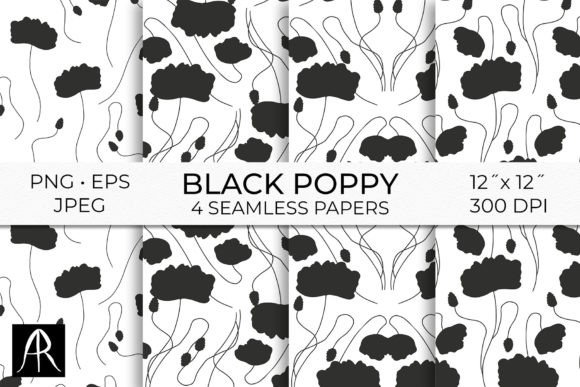
The intersection of nature and graphic design has long produced some of the most enduring visual themes in creative history. Among these, the poppy flower stands out not just for its botanical significance, but for its striking silhouette potential. When translated into monochrome poppy flowers patterns, this floral motif transcends simple decoration to become a powerful tool for branding, textile production, and digital artistry. The specific collection featuring four distinct black and white poppy flower silhouette seamless patterns offers a level of adaptability that few other assets can match.
These designs are more than just aesthetic choices; they represent a workflow solution for professionals who require high-fidelity graphics across multiple mediums. Whether you are a fashion designer preparing a print run or a web developer crafting a landing page, the availability of these patterns in EPS, PNG, and JPG formats ensures that your project remains consistent from concept to final delivery.
The Power of Silhouette in Modern Design
Why do designers consistently return to silhouette-based imagery? The answer lies in clarity and versatility. A monochrome poppy flower silhouette seamless pattern strips away the distraction of color gradients and complex textures, leaving only the essential form. This reductionist approach allows the shape of the poppy to communicate instantly with the viewer. In a crowded marketplace, where attention spans are short, the bold contrast of black against white creates an immediate visual impact.
The beauty of these four unique patterns is found in their variation. While they all share the same subject matter—the poppy—they differ in arrangement, density, and flow. Some may feature tightly clustered blooms suitable for a textured background, while others might utilize spaced-out silhouettes that allow negative space to breathe. This variety within a single set means that a creator does not need to purchase multiple collections to find the right fit for a specific project.
Furthermore, the monochromatic nature of these files makes them incredibly easy to manipulate. Because the source material is strictly black and white, it can be recolored in post-production without losing integrity. A designer can take a black silhouette and shift it to a deep crimson or a soft pastel blue, maintaining the sharp edges and clean lines that define the original vector quality.
Technical Specifications and Format Versatility
In the professional realm, file format is often as critical as the design itself. The limitations of one format can halt a project, whereas the flexibility of another can unlock new possibilities. This specific collection addresses every major requirement by providing three distinct file types: JPG, PNG, and EPS.
The inclusion of 4 JPG 3600x3600 px, 300 dpi files is particularly valuable for print-on-demand services and large-scale physical applications. At 300 dots per inch (dpi), these images possess the resolution necessary for high-quality printing on fabrics, posters, and packaging materials. The square dimensions of 3600 pixels provide ample room for cropping and scaling, ensuring that the pattern remains crisp even when expanded to cover a full roll of wallpaper or a large banner.
For digital interfaces and projects requiring transparency, the 4 PNG with transparent background 3600x3600 px, 300 dpi files are indispensable. Transparency allows the pattern to overlay existing images or website backgrounds without the unsightly white box that often accompanies standard raster images. This is crucial for creating watermarks, overlays on photography, or integrating the poppy motifs into complex UI/UX designs where the background needs to remain visible.
Perhaps the most significant asset for longevity and scalability is the 4 EPS 10 vector files. Vector graphics are defined by mathematical equations rather than pixels, meaning they can be scaled to the size of a billboard or shrunk to the size of a business card without any loss of quality. The EPS 10 format is widely compatible with industry-standard software like Adobe Illustrator, CorelDRAW, and Affinity Designer. This ensures that designers can edit individual elements, adjust spacing, or modify the curve of the petals if a custom alteration is required for a client's specific brand guidelines.
Applications Across Industries
The utility of monochrome poppy flower silhouette seamless patterns extends far beyond simple digital wallpapers. Their neutral yet striking appearance makes them applicable across a diverse spectrum of industries, each leveraging the patterns for different strategic ends.
- Textile and Fashion Design: The fashion industry relies heavily on repeatable patterns. These seamless designs are perfectly suited for fabric printing. A designer could use the dense version of the pattern for a statement dress or the sparse version for a sophisticated scarf. The high DPI ensures that the ink adheres cleanly to the fiber, while the vector files allow for resizing the repeat unit to fit specific garment cuts.
- Packaging and Branding: For businesses looking to convey elegance and timelessness, these patterns offer a sophisticated backdrop. Imagine a luxury tea company using the silhouette pattern on their packaging, or a stationery brand incorporating the poppies into their notebook covers. The black and white theme suggests minimalism and high-end quality, allowing the product itself to stand out against the subtle background.
- Digital Marketing and Web Design: In the digital space, load times and visual hierarchy are paramount. Using these patterns as background textures adds depth to a website without overwhelming the content. The transparent PNG versions allow for layering effects, such as placing the poppy silhouettes over a gradient or a photograph to create a mood board effect for blog headers or social media campaigns.
- Interior Decor and Home Goods: The trend towards minimalist interior design has kept floral motifs in high demand, provided they are stylized correctly. These patterns can be applied to throw pillows, curtains, and wall murals. The seamless nature of the design ensures that there are no visible breaks or awkward joints when the pattern is repeated across a large surface area.
- Educational and Research Materials: Educators and researchers often need to create handouts, presentations, or posters that are both engaging and professional. Using these patterns can elevate the visual appeal of academic slides or printed reports, making the content more accessible and visually interesting without compromising the seriousness of the subject matter.
Workflow Integration for Creators
Integrating these assets into a creative workflow requires an understanding of how to leverage the strengths of each format. For a typical project lifecycle, the process usually begins with the vector files. An illustrator will import the EPS files into their workspace to test various layouts and color schemes. Once the composition is finalized, the design is exported to the appropriate raster format for the final output stage.
If the project involves web development, the PNG files with transparent backgrounds are the primary choice. Developers can embed these directly into CSS or use them as background-image assets, ensuring that the poppy silhouettes render sharply on high-DPI screens like Retina displays. The 3600px width provides enough pixel density to handle zoom interactions without blurring.
For print workflows, the JPG files serve as the final deliverables. Printers prefer high-resolution JPEGs for quick processing and compatibility with RIP (Raster Image Processor) software. By starting with the vector source and converting to the high-res JPG, creators ensure that the final product meets the strict standards of commercial printing houses. This multi-format approach eliminates the common bottleneck of having to recreate artwork because the initial file type was unsuitable for the medium.
Considerations for Commercial Use
While these patterns offer immense value, it is important for users to consider the legal and practical aspects of commercial usage. When utilizing Monochrome Poppy Flower Silhouette Seamless Patterns for business purposes, verifying the licensing terms is essential. Most professional stock assets come with clear licenses that dictate whether the image can be used for end products sold to third parties or restricted to internal use.
Another consideration is the uniqueness of the design. Since the poppy is a popular motif, there is a risk of the pattern appearing too similar to existing works if not customized. However, the availability of four distinct variations helps mitigate this issue. By mixing and matching the patterns or altering the scale and orientation, a brand can create a unique visual identity that distinguishes it from competitors.
Additionally, the monochromatic palette offers a strategic advantage in branding consistency. It removes the guesswork associated with color selection, allowing the brand to focus on typography and messaging. The stark contrast of the black and white design ensures legibility and recognition across various media channels, from small mobile screens to large outdoor billboards.
The Timeless Appeal of Floral Minimalism
Trends in design often cycle, returning to styles that prioritize simplicity and form. The current landscape of graphic design favors "less is more," and nothing embodies this philosophy better than a well-executed silhouette. The beautiful set of 4 black and white poppy flower silhouette seamless patterns taps into this zeitgeist, offering a design element that feels both contemporary and classic.
Unlike colorful floral prints that can feel dated quickly due to shifting color trends, a monochrome design remains relevant indefinitely. The poppy itself carries connotations of remembrance, sleep, and peace, adding a layer of emotional resonance to the visual design. When combined with the precision of vector graphics and the flexibility of modern file formats, these patterns become a staple resource for any serious creator.
Whether you are a hobbyist looking to add a touch of elegance to a personal scrapbook or a business owner seeking to revitalize your brand's visual language, these assets provide the foundation needed to succeed. The combination of high resolution, vector scalability, and versatile formatting ensures that the effort invested in acquiring these patterns yields a return in the form of professional-grade results across every platform.
In conclusion, the integration of monochrome poppy flowers patterns into your creative toolkit is a decision rooted in practicality and aesthetic excellence. They bridge the gap between artistic expression and technical requirement, offering a seamless transition from digital conception to physical reality. As the demand for high-quality, adaptable design resources continues to grow, sets like this stand out as essential components for anyone committed to producing work of the highest standard.