Integrating Japanese Waves Seamless Patterns into Modern Design Projects
The aesthetic of traditional Japanese art has long served as a wellspring of inspiration for global creators, offering a unique blend of minimalism, nature, and fluid motion. Among the most enduring motifs in this rich visual heritage are the depictions of water, specifically the rhythmic and powerful Japanese Waves Seamless Patterns. These designs do more than simply decorate a surface; they convey a sense of movement, tranquility, and philosophical depth that resonates across various disciplines. Whether you are a textile manufacturer looking to add cultural nuance to a new collection, a graphic designer seeking to elevate a digital interface, or an educator illustrating concepts of flow and change, these patterns offer a versatile toolkit for visual storytelling.
The Artistic Philosophy Behind the Wave Motif
To fully appreciate the utility of Japanese Waves Seamless Patterns, one must first understand the cultural context from which they emerge. In Japanese aesthetics, water is rarely static; it represents life, change, and the passage of time. The iconic wave imagery, often associated with ukiyo-e woodblock prints like Hokusai's "The Great Wave," captures a moment of dynamic tension between power and grace. However, modern interpretations often lean towards the serene, focusing on the gentle undulation of water rather than its destructive potential.
This shift allows designers to utilize these patterns to evoke specific emotional responses. A seamless pattern implies continuity, suggesting that the design extends infinitely without interruption. This characteristic is particularly valuable in applications where the eye travels across a large area, such as fabric rolls or website backgrounds. By incorporating high-resolution visuals that capture intricate details, creators can infuse their projects with a touch of tranquil elegance that feels both timeless and contemporary.
Practical Applications Across Industries
The versatility of these patterns makes them applicable to a wide array of sectors. The ability to seamlessly tile these designs means they can be scaled up or down without losing integrity, making them ideal for large-scale production as well as intimate crafts.
- Textile and Fashion Design: For fashion designers, Japanese Waves Seamless Patterns provide a sophisticated alternative to generic floral or geometric prints. When printed on silk, cotton, or synthetic blends, the flowing lines of the waves mimic the movement of the fabric itself. This creates a garment that appears to move even when the wearer is still. The patterns are equally effective in home textiles, such as curtains, upholstery, and bedding, where they can transform a room into a sanctuary of calm.
- Paper Goods and Stationery: In the realm of stationery, these patterns serve as a backdrop that enhances readability while adding artistic flair. Imagine a notebook cover featuring a subtle, monochromatic wave motif; it offers a professional yet creative look suitable for business meetings or personal journaling. Greeting cards, packaging, and invitations benefit from the inherent sense of rhythm found in wave designs, guiding the viewer's eye naturally across the page.
- Digital Interfaces and Web Design: As screen real estate becomes more competitive, background textures play a crucial role in user experience. High-resolution wave patterns can be used to create depth in web headers or mobile app backgrounds without distracting from the primary content. The soothing nature of the imagery can reduce cognitive load, creating a more pleasant browsing environment.
- Crafts and DIY Projects: Hobbyists often seek materials that allow for personal expression. Scrapbooking enthusiasts might use these patterns to document travel memories related to coastal regions, while crafters working with paper mache or decoupage can apply these designs to create unique decorative objects. The seamless nature ensures that complex shapes, like wrapping paper for oddly sized gifts, remain visually consistent.
Technical Advantages of High-Resolution Seamless Files
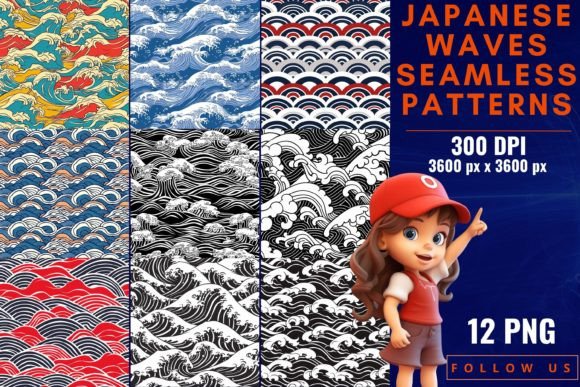
When sourcing digital assets for professional work, resolution and tiling quality are paramount. Our collection features high-resolution visuals capturing the intricate details of traditional Japanese wave motifs. This technical specification is not merely a marketing point; it is a functional necessity for print-on-demand services and large-format printing.
A common pitfall in using digital patterns is pixelation when scaling up. Low-resolution files lose detail, resulting in jagged edges that ruin the illusion of fluid motion. By utilizing high-definition versions of Japanese Waves Seamless Patterns, professionals ensure that every curve and crest of the wave remains crisp, regardless of the output size. Furthermore, true seamless tiling means there are no visible seams or breaks when the image is repeated. This allows for the creation of continuous backdrops that look professionally finished, eliminating the need for manual editing to hide join lines.
The clarity of these designs also supports advanced printing techniques. Whether using screen printing, sublimation, or digital inkjet, the fine lines and gradients within the wave patterns reproduce accurately, maintaining the intended color palette and texture. This fidelity is essential for brands that rely on visual consistency to maintain their identity.
Curating a Collection for Specific Needs
With over 12 captivating designs available, selecting the right pattern requires an understanding of the project's specific goals. Not all wave patterns are created equal; some may feature bold, contrasting colors suited for statement pieces, while others might utilize soft pastels for a subtle background effect.
- Color Palette Considerations: Traditional Japanese art often employs specific color palettes, such as indigo blues, deep ocean greens, or soft cherry blossom pinks. When choosing a pattern, consider how these colors will interact with your existing brand guidelines or material choices. A deep blue wave pattern might convey authority and stability, whereas a lighter, frothy white-on-blue design could suggest freshness and lightness.
- Scale and Density: The density of the wave elements affects the overall perception of the design. A dense pattern with many overlapping crests can feel energetic and busy, suitable for accessories or focal points. Conversely, a sparse pattern with wide spaces between the waves offers a minimalist aesthetic, perfect for corporate branding or educational materials where clarity is key.
- Mood Alignment: The goal of using Tranquil Japanese Waves Seamless Patterns is often to instill a sense of peace. If the objective is to create a calming atmosphere, select designs that emphasize smooth, rolling curves rather than sharp, jagged peaks. The visual rhythm should match the desired emotional tone of the final product.
Implementation Strategies for Creators
Incorporating these patterns into a workflow requires more than just downloading a file; it involves thoughtful integration. For digital artists, software like Adobe Photoshop or Illustrator offers tools to adjust opacity, blend modes, and saturation to make the pattern complement rather than overpower other elements. Experimenting with overlay modes can create depth, allowing text or other graphics to sit clearly on top of the wave background.
For physical manufacturers, sampling is a critical step. Before committing to a full production run, test the pattern on different substrates. The way ink interacts with rough canvas versus smooth satin can drastically alter the appearance of the wave details. Understanding these material properties ensures that the final product matches the digital preview.
Educators and researchers can also find value in these resources. Visual aids that incorporate cultural motifs can help explain complex concepts about fluid dynamics, art history, or cross-cultural design trends. The patterns serve as tangible examples of how traditional art forms can be adapted for modern utility, bridging the gap between historical appreciation and contemporary application.
The Enduring Appeal of Tranquility in Design
In an era characterized by digital noise and fast-paced information consumption, there is a growing demand for design that offers respite. The Tranquil Japanese Waves Seamless Patterns collection answers this call by bringing a piece of natural serenity into artificial environments. The rhythmic flow of these patterns mimics the breathing cycle, providing a subconscious anchor for the viewer.
By elevating designs with the enchanting and timeless aesthetic of Japanese wave patterns, creators can distinguish their work in a crowded marketplace. It is a choice that signals attention to detail, cultural awareness, and a commitment to quality. Whether you are designing a luxury hotel lobby, a children's book about the ocean, or a simple set of business cards, the inclusion of these motifs adds a layer of sophistication that speaks volumes.
Unleash your creativity as you seamlessly incorporate these enchanting patterns into your projects. The possibilities are as vast as the ocean itself. From transforming everyday textiles into works of art to adding a burst of Japanese beauty to digital crafts, the collection offers a foundation for innovation. Embrace the serene and elegant ambiance of these designs, and let them guide your creative journey toward refined excellence.
We invite you to explore the full range of options available. Follow our store for more free and premium files to keep your portfolio fresh and inspired. With each download, you gain access to a curated selection of high-quality assets designed to support your vision. Let the rhythmic flow of these patterns create an atmosphere of calm and sophistication in your next endeavor, proving that traditional artistry remains a vital force in modern creativity.